Robbery Bob - King of Sneak
- 4.4
- Rating
- 100.00M
- Installs
- Free
- Price
 Analysis by App-foxy
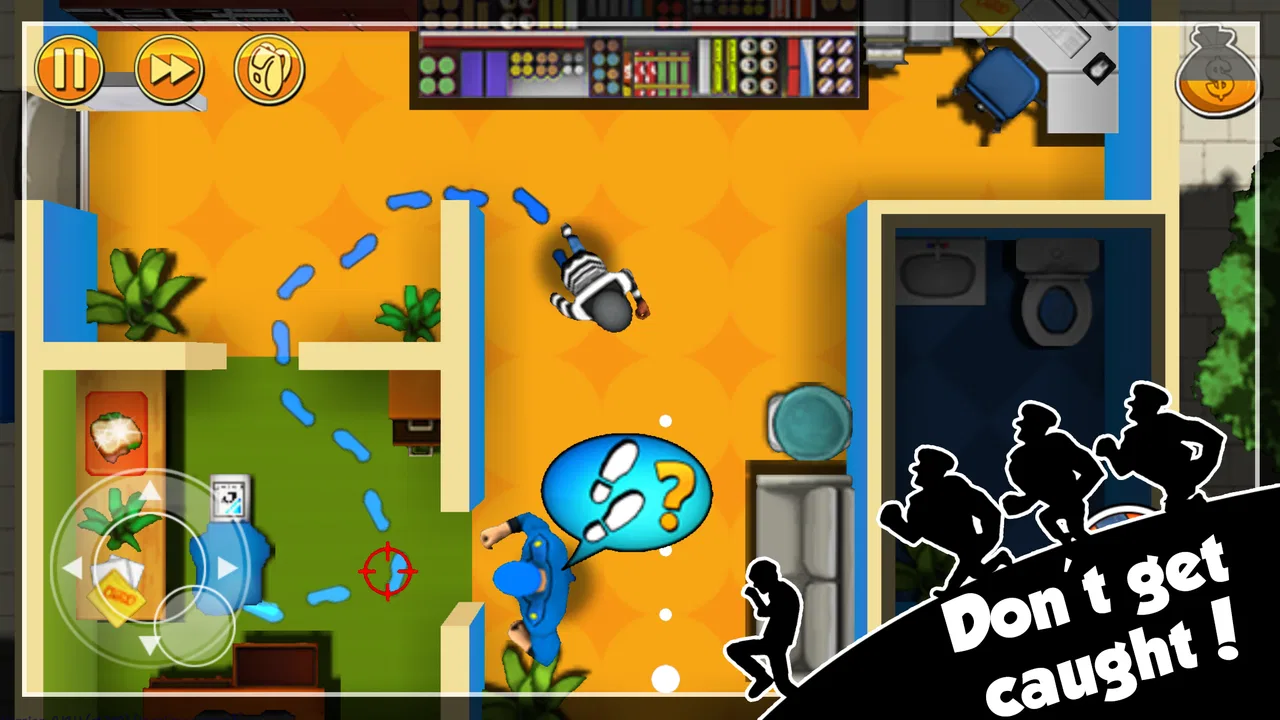
I expected a light stealth game when I started Robbery Bob - King of Sneak, but what kept me playing was the way each small mistake immediately changes the mood of a level. The first action is simple: move Bob through a guarded area, avoid being noticed, and take what he came for. The interesting part is what happens between those actions. A clear path can disappear when a guard turns, a safe-looking corner can become a trap, and a successful escape feels satisfying because I had to read the situation rather than simply react quickly.
This is an action game from Deca_Games, but it plays more like a compact stealth-and-puzzle challenge than a traditional fighting game. It is free to start, aimed at players aged 10 and over, and has built a very large audience, with over 100 million installs and an average rating of 4.4 from around 1.7 million ratings. Those figures make sense to me after spending time with it: the controls are approachable, the humor keeps the tone relaxed, and the missions are easy to understand even when completing them cleanly takes patience.
How the first move teaches you to think like a thief
The opening minutes do a good job of making the central idea understandable without burying it in complicated instructions. I move Bob, watch the environment, look for openings, and try to reach the objective without drawing attention. That sounds modest, yet the game gets its character from the tension between movement and observation. I am not only asking, “Can Bob get there?” I am asking, “When should he move, where can he hide, and what will happen if I take this route?”
You May Also Like

 AccuWeather: Weather Radar
AccuWeather Review: A Quick, Clear Forecast for Everyday Decisions
For everyday plans, the best forecast is the one you can understand quickly. AccuWeather makes rain timing, radar, and local conditions easy to act on, with a few trade-offs.

 Hill Climb Racing
Why Hill Climb Racing Still Turns Crashes Into One More Run
A tiny car, a bumpy hill and one more upgrade: Hill Climb Racing keeps resurfacing because its simple chaos makes every near-miss feel personal.

 AliExpress - Shopping App
AliExpress Makes Global Shopping Feel Personal, but Shoppers Bear the Risk
AliExpress turns a global marketplace into a pocket-sized discovery engine. Its reach is useful, its shopping loop compelling, and its trade-offs easy to miss.

 Lords Mobile: Kingdom Wars
Lords Mobile Is a Kingdom-Building Routine, Not a Quick Match
A case-by-case verdict on the building, battles, device demands, and social commitments that make Lords Mobile rewarding for some players and exhausting for others.

 PDF Scanner app - TapScanner
TapScanner Makes Paperwork Easier to Capture, Check, and Share
TapScanner makes scanning with a phone feel less like a rescue operation and more like a dependable step in getting work done. Its capture tools are useful, though not flawless.

 Block Blast!
 Shows How Much a Puzzle Game Can Leave Out
A quiet grid game shows why puzzle players increasingly value instant clarity, repeatable skill and low-pressure play—and where the genre still needs to catch up.
More From Our News Desk
View All News


The touch controls are suited to short sessions. I can make a quick adjustment when a guard changes direction, and the game does not require the kind of precision I associate with a competitive action title. That makes it comfortable on a phone, particularly when I have only a few minutes. At the same time, the simplicity creates a useful limitation: success depends less on complicated input and more on understanding the level.
That distinction matters. If you want constant combat, elaborate character builds, or a fast stream of enemies, this is not the right kind of action game. Bob’s strength is vulnerability. He is funny and expressive, but he is not a powerhouse who can solve every problem by attacking. The game asks me to stay alert, and that makes ordinary movement feel meaningful.
My most useful early habit was to stop treating every open space as an invitation to move. I first watch the rhythm of nearby threats, then choose a route that gives me room to correct a mistake. This is more reliable than rushing toward the visible objective. A short route is not always the best route if it leaves Bob exposed with no place to recover.
The visual presentation supports this learning process. Important objects and characters are readable at a glance, which is valuable on a small screen. I can generally understand the immediate problem without pausing to study a crowded scene. The playful tone also softens failure. Being caught feels like a setback, not a punishment designed to make me quit.
Why the feedback rhythm works
The game’s strongest quality is its feedback rhythm: move, observe, risk a little, receive an immediate response, and adjust. When I stay hidden and make progress, the reward is not only the objective itself. I also feel that I have correctly interpreted the space. When I am spotted, the lesson is equally direct. I learn that my timing, route, or assumption was wrong.
This creates a pleasant form of trial and error. I do not need a long explanation after a failed attempt because the cause is usually visible in the moment. Perhaps I moved while a guard was looking in my direction, approached from an unsafe angle, or committed to a route without leaving myself an escape. The game encourages me to replay the situation with a different decision rather than abandon the level.
I especially like that the tension comes from anticipation. The most satisfying moments are often quiet ones: waiting for an opening, edging around danger, or deciding whether the next step is worth the risk. The action is therefore measured by information. Every movement tells me something about the level, and every mistake improves my understanding if I pay attention.
That rhythm also makes the game suitable for different kinds of players. A casual player can focus on reaching the goal and enjoying the comic presentation. A more methodical player can try to improve a route, reduce unnecessary exposure, and make each attempt cleaner. The same level can therefore offer a basic challenge and a more demanding personal target without requiring a separate competitive mode.
There is a trade-off, though. Players who dislike repeating a stage after a mistake may find the loop frustrating. The game expects me to accept resets as part of learning. I found that fair when the failure was clearly my fault, but less satisfying when I was impatient and wanted to push forward without observing. This is a stealth game first, so it rewards restraint more than reflexes.
The reward is more than reaching the exit
Robbery Bob works because the reward arrives in layers. The obvious reward is completing the immediate objective and getting Bob safely through the situation. The deeper reward is solving the level with a better understanding of its timing. I often finished an attempt already thinking about how I could make the next one smoother, which is a strong sign that the core design is doing its job.
There is also a small emotional reward in the character himself. Bob’s presentation keeps the mood playful, so the game does not feel grim even though being detected interrupts the plan. That balance is important for a mobile title. I can enjoy the fantasy of sneaking around without feeling that every mistake has turned the session into a serious punishment.
For everyday use, this makes the game a good companion for short breaks. If I am waiting for an appointment or taking a quick pause between tasks, I can play one attempt, learn a little, and stop without needing to remember a complicated story. If I have more time, I can continue because the desire to improve the previous attempt provides its own momentum.
One practical tip is to separate “progress” from “perfection.” On a first attempt, I try to understand the route and identify the dangerous moments instead of forcing a flawless run. On the next attempt, I change one decision at a time. This prevents the common mistake of changing everything after a failure and then not knowing what actually improved the result.
Another useful approach is to think about the return journey before committing to the objective. Reaching the loot is only half of the problem if the route out is exposed. I found that planning the exit early makes my choices calmer, especially when the most obvious path creates a narrow escape. This is the kind of small strategic habit that the store summary cannot communicate, but it is central to enjoying the game.
The free entry point is helpful for trying the loop without a purchase. The game includes in-app purchases ranging from $0.99 to $8.49 per item, so players who prefer a completely uninterrupted free experience should pay attention to the purchase elements and decide in advance whether they want to spend. I would approach those options as conveniences rather than a reason to begin playing. The core appeal is the stealth decision-making, not collecting purchases.
Why each reset makes another session tempting
A reset in this game is not merely a restart button; it is the point where the feedback becomes useful. I return to the beginning with a clearer idea of what matters. The guard’s movement is no longer an unknown, the risky corner is familiar, and the route I considered safe may now look obviously inefficient. That knowledge turns a failed attempt into preparation for the next one.
This loop is particularly effective because the game keeps the goal understandable. I am not resetting after a vague setback with no clear purpose. I am resetting because I want to try the same situation with better timing. The desire to begin again comes from a specific question: can I pass the point that stopped me, and can I do it without repeating the same mistake?
Still, the reset structure will not suit everyone. If you prefer games that constantly introduce new mechanics or let you overpower earlier obstacles, the repetition may feel narrow. This is a focused experience built around reading situations. Its variety comes from how I approach the challenge, not from turning Bob into a dramatically different kind of character every few minutes.
I also think the game is better for players who enjoy gradual improvement than for people looking for a relaxing background activity. Although the cartoon style is friendly, the levels still ask for attention. Playing while distracted can lead to careless mistakes, and careless mistakes can make the experience seem more irritating than it really is. When I give it even a little concentration, the same moments become satisfying puzzles.
The age rating of Everyone 10+ fits the tone I experienced. The action is presented in a humorous, accessible way rather than as a harsh or realistic crime simulation. Parents should still remember that the game is built around sneaking and stealing as fictional objectives, while younger players may also encounter optional purchase prompts. For a child using a shared device, checking the device’s purchase controls is sensible.
Where it stands beside other action games
Compared with reflex-heavy action games, this one is slower and more deliberate. A quick shooter or arcade fighter may give me excitement through rapid input, while Bob gives me satisfaction through anticipation. Compared with large adventure games, it is much easier to pick up for a short session and does not ask me to manage a broad world before I can enjoy the next challenge.
It also differs from pure puzzle games because movement and timing matter. I am not simply selecting the correct answer from a static arrangement. The situation changes as I move, and my route has consequences. That combination makes it a useful middle ground for someone who wants action without constant combat and puzzles without long stretches of abstract problem-solving.
On the other hand, a dedicated stealth game on a larger screen may offer deeper systems, more complex environments, or greater control. If that is what you want, this mobile format may feel intentionally compact. I see that as a design choice rather than a flaw, but it does mean expectations matter. Bob is best when I want a clear, humorous stealth challenge that fits naturally into phone play.
The current version is 1.36.2 and it runs on Android 7.0 or later. That broad compatibility is useful for people with older supported devices, although the actual comfort of play will still depend on the phone’s screen and responsiveness. I would install it on a device that handles touch input reliably, because the game’s challenge should come from decisions, not from fighting an unresponsive display.
Who should play, and who should pass
I would recommend it to players who enjoy sneaking, timing, and learning through quick retries. It is especially suitable for someone who wants an action game that can be understood immediately but still rewards careful thinking. Families looking for a colorful game for older children may also find the tone approachable, provided they are comfortable with the fictional robbery theme and manage optional purchases appropriately.
It is a weaker choice for anyone who needs a long narrative, deep customization, online competition, or nonstop action. It may also disappoint players who consider restarting a failure rather than part of the fun. The best audience is not defined by age alone; it is defined by patience. If you enjoy watching a pattern, testing a route, and improving after a mistake, the design has a lot to offer.
My everyday scenario for it is simple: I open it during a short wait, attempt a level, and either finish with a smile or learn exactly where my plan broke down. I can close the game after that without feeling lost. Later, I return because the unfinished problem remains clear in my mind. That is a better reason to resume than a noisy stream of rewards, and it explains why the loop stays appealing.
My verdict on the complete loop
After playing through its central rhythm, I see Robbery Bob - King of Sneak as a well-focused mobile action game whose best feature is the connection between action, feedback, reward, reset, and another attempt. The first move is easy to understand, the response to that move is immediate, and the reset gives me useful information instead of simply wasting my time.
It is not a replacement for a deep console-style stealth adventure, and it will not satisfy players who want every session to be different from the last. Its occasional friction comes from the same quality that makes it work: I must slow down, observe, and accept that a careless decision can send me back. For me, that trade-off is worthwhile because the next attempt usually feels smarter.
Deca_Games has made a free game that is easy to recommend when you want compact stealth puzzles with a playful personality. I would start without spending anything, learn whether the retry loop suits me, and treat the optional purchases cautiously. If the idea of escaping after a carefully timed theft sounds more appealing than defeating waves of enemies, this is one of the more approachable ways to get that feeling on a phone.
My final judgment is positive, with one clear condition: play it as a game of observation rather than a race. When I do that, every failed attempt has a purpose, every successful escape feels earned, and the reason to begin another session arrives naturally. That is the real strength of Bob’s adventure—not the act of stealing alone, but the small satisfaction of understanding a situation well enough to slip through it.
FAQs for Robbery Bob - King of Sneak
01What is Robbery Bob – King of Sneak about?
Robbery Bob – King of Sneak is a stealth-based action game in which you control Bob, a clumsy thief trying to complete different burglary missions. Instead of fighting your way through every level, you usually need to avoid guards, security cameras, alarms, animals, and other obstacles. The game combines sneaking, light puzzle-solving, humorous animations, and short objectives across a variety of locations.
02Is Robbery Bob – King of Sneak free to download and play?
Yes, Robbery Bob – King of Sneak can generally be downloaded for free on supported Android and iOS devices. However, the free version may include advertisements and optional in-app purchases, depending on the platform and current release. These purchases can provide convenience or remove ads, but they are not normally required to experience the main missions and basic gameplay.
03Does the game require an internet connection?
Many of the core missions in Robbery Bob – King of Sneak can be played offline once the game has been installed and its necessary files are available. An internet connection may still be needed for downloading updates, displaying certain advertisements, restoring purchases, or accessing promotional features. If you plan to play while traveling, it is sensible to launch the game online first and confirm that the available content works offline.
04Is Robbery Bob – King of Sneak suitable for children?
The game is presented in a cartoon style, with exaggerated characters and humorous situations rather than realistic violence. Its controls and objectives are relatively easy to understand, making it accessible to younger players. Nevertheless, parents should review the age rating, advertising, and optional in-app purchases on their child’s device. The central theme involves stealing, although it is treated as lighthearted fictional entertainment.
05What devices and skills are needed to play Robbery Bob?
Robbery Bob – King of Sneak is designed for touchscreen play and does not require advanced gaming hardware on many modern Android phones, iPhones, or iPads. Performance can vary according to the device, operating-system version, available storage, and the specific game update. Success depends more on timing, observation, and patience than fast reflexes, since players must study patrol routes and move carefully through each level.
Pros
- Simple controls make sneaking accessible for casual players.
- Many levels offer different layouts
- objectives
- and guard patterns.
- Humorous animations and character reactions add personality.
- Optional objectives encourage replaying completed stages.
- Runs smoothly on most modern Android and iOS devices.
Cons
- Some later stages can feel repetitive after extended play.
- Mistakes may require restarting sections rather than quick recovery.
- In-app purchases can speed progress or provide useful advantages.
- The small-screen interface may occasionally obscure nearby obstacles.
- Ads can interrupt the experience for players using the free version.

Robbery Bob - King of Sneak
Gallery